Screens
#include "chili/screens.hpp"
Ready-made screens around a game. Each draws with chili::theme and has virtual hooks to restyle it.
| Class | For |
|---|---|
NameEntry |
three-letter name for a new high score |
TextScreen |
help and credits pages |
ScoreTable |
drawing a HighScores table |
Name entry
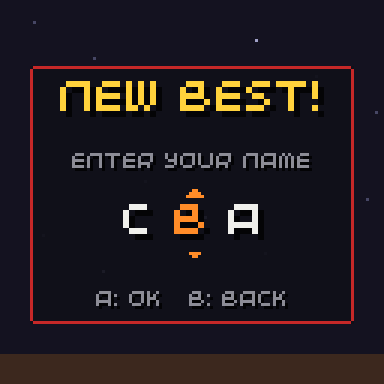
Arcade-style: three letters A to Z.
| Button | Does |
|---|---|
| Up / down | Next / previous letter, with wrap (Z to A) |
| Left / right | Moves between letters, stops at the ends |
| A | Next letter; on the last letter, done |
| B | Back one letter |
chili::NameEntry name;

void enter_name() {
  name.start(save.data.last_name);  // players usually keep their name
}

void update(uint32_t time) {
  if(name.update()) {               // true when done
    ScoreEntry e{};
    memcpy(e.name, name.name(), 4);
    e.score = score;
    save.data.scores.insert(rank, e);
    memcpy(save.data.last_name, name.name(), 4);
    save.store();
    show_results();
  }
}

void render(uint32_t time) {
  name.render(Point(64, 74), time);  // three letters centred here, 18 px apart
}
| Member | Does |
|---|---|
void start(const char *last = "AAA") |
Starts over from last. Anything not A-Z becomes A. |
bool update(uint32_t pressed = buttons.pressed) |
True when the name is done. |
const char *name() |
The three letters, null-terminated. |
int cursor() |
The selected letter, 0 to 2. |
void render(Point center, uint32_t time) |
Draws the letters. |
hook draw_letter(char, Point center, bool selected, uint32_t time) |
Default: the letter at 2x, with bobbing arrows on the selected one. |
Text screen
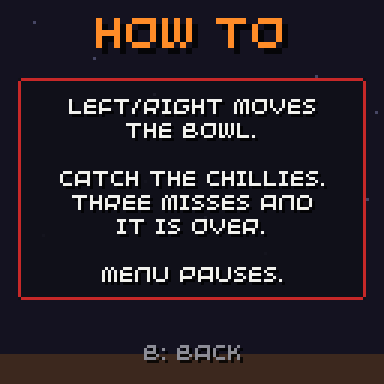
A help or credits page: a title, lines in a panel and "B: BACK". A, B or MENU closes it.
chili::TextScreen credits("CREDITS", {
  "snek v1.0.0",
  "",
  "Game: TeriyakiGod",
  "Made with 32blit",
  "chilichip.eu",
});

void update(uint32_t time) {
  if(credits.update()) go_to_title();
}

void render(uint32_t time) {
  draw_background(time);
  credits.render(time);
}
| Member | Does |
|---|---|
TextScreen(const char *title, {lines...}) |
Makes the page. |
bool update(uint32_t pressed = buttons.pressed) |
True when closed. Plays UiSound::back. |
virtual void render(uint32_t time) |
Draws the page. Override it for your own layout. |
title, lines, line_height |
Change them any time. line_height is 8 by default. |
Eight to nine lines fit on the 128x128 screen with the default layout.
Score table
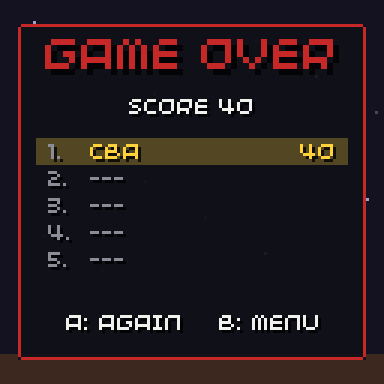
Draws any HighScores table, one row per slot. The row at highlight (the score just added) blinks.
chili::ScoreTable table;

void render(uint32_t time) {
  table.render(save.data.scores, Rect(12, 46, 104, 45), new_rank, time);
}
Entries need char name[4] and uint32_t score. Empty slots (score 0) show ---.
| Member | Does |
|---|---|
render(const HighScores<...> &table, Rect area, int highlight = -1, uint32_t time = 0) |
Draws the rows from the top of area. |
int row_height |
Pixels per row. Default 9. |
hook std::string score_text(uint32_t score) |
How a score reads. Default: the number. |
hook draw_row(int place, const char *name, uint32_t score, Rect row, bool highlight, uint32_t time) |
One row. name is nullptr for an empty slot. |
Show times
For a lower-is-better table of times, override score_text:
class TimeTable : public chili::ScoreTable {
public:
  std::string score_text(uint32_t ms) const override {
    char buf[8];
    snprintf(buf, sizeof(buf), "%lu:%02lu", ms / 60000, ms / 1000 % 60);
    return buf;
  }
};
Add a column
Override draw_row, call the default, then draw your column. The place tells you which entry it is:
class SnekTable : public chili::ScoreTable {
protected:
  void draw_row(int place, const char *name, uint32_t score, Rect row, bool hl, uint32_t time) override {
    chili::ScoreTable::draw_row(place, name, score, Rect(row.x, row.y, row.w - 20, row.h), hl, time);
    if(name) fx::text(speed_tag(save.data.scores[place]), Point(row.x + row.w - 4, row.y + 1), dim, TextAlign::top_right);
  }
};